Interactions: Sequence, Balances and Causality
Integration Is Not Adding Removal Percentages
The T1 train brings together electrocoagulation, electrooxidation, hydrodynamic cavitation and aeration. Its value as a proprietary commercial method lies in organizing operations that can change one another's working conditions. An operation's outlet is not necessarily the same matrix at lower concentration: it may contain new species, different particle sizes, altered oxygen demand and solids generated during treatment.
A library of published results therefore does not constitute a formula adding four percentages. Studies may use different matrices, doses, materials, times and sample preparations. Even with the same feed, the response of an isolated operation does not automatically determine its response after another operation. Integration requires describing what reaches each stage and what leaves the process boundary.
Complementarity, intensification and synergy should be distinguished. Complementarity means that different operations address different fractions or functions. Intensification denotes improvement in a defined metric, such as required time under comparable conditions. Synergy requires exceeding an explicit no-interaction reference; it is not established merely because the complete train improves on each individual operation.
Order Changes the Question
In an EC, separation and EO sequence, removing solids can reduce the material reaching the subsequent cell. A favourable hypothesis is that this releases capacity to treat another fraction; an alternative is that substances contributing to transport or particular pathways are removed. The net direction of the effect cannot be decided from the diagram.
When HC precedes EC, modified particles or dispersion may change subsequent coagulation. When HC follows floc formation, it may alter floc integrity and separation. Both are engineering hypotheses requiring measurements of size, separable fraction and pollutant-load fate. HC is not declared always to improve or destroy flocs.
Aeration introduces another dependency: it can change DO, mixing and gas-liquid contact simultaneously. When coupled with HC, attributing every change to oxygen is incorrect unless the hydraulic modification is controlled. When combined with EO, oxygen presence likewise does not demonstrate dominance of a particular electrochemical pathway. Variables capable of distinguishing explanations must be observed.
| Proposed sequence | Causal question | Decisive observation |
|---|---|---|
| EC, separation, EO | Does accessible load change? | Fractions before EO |
| HC before EC | Does aggregation change? | Final separability |
| HC after EC | Does the floc change? | Solids and distribution |
| HC with air | Gas or hydraulics? | OTR and pressures |
These questions do not prescribe a universal sequence. They help select an experiment whose outcome can refute the designer's preferred explanation.
Water, Solids and Gas Within One Boundary
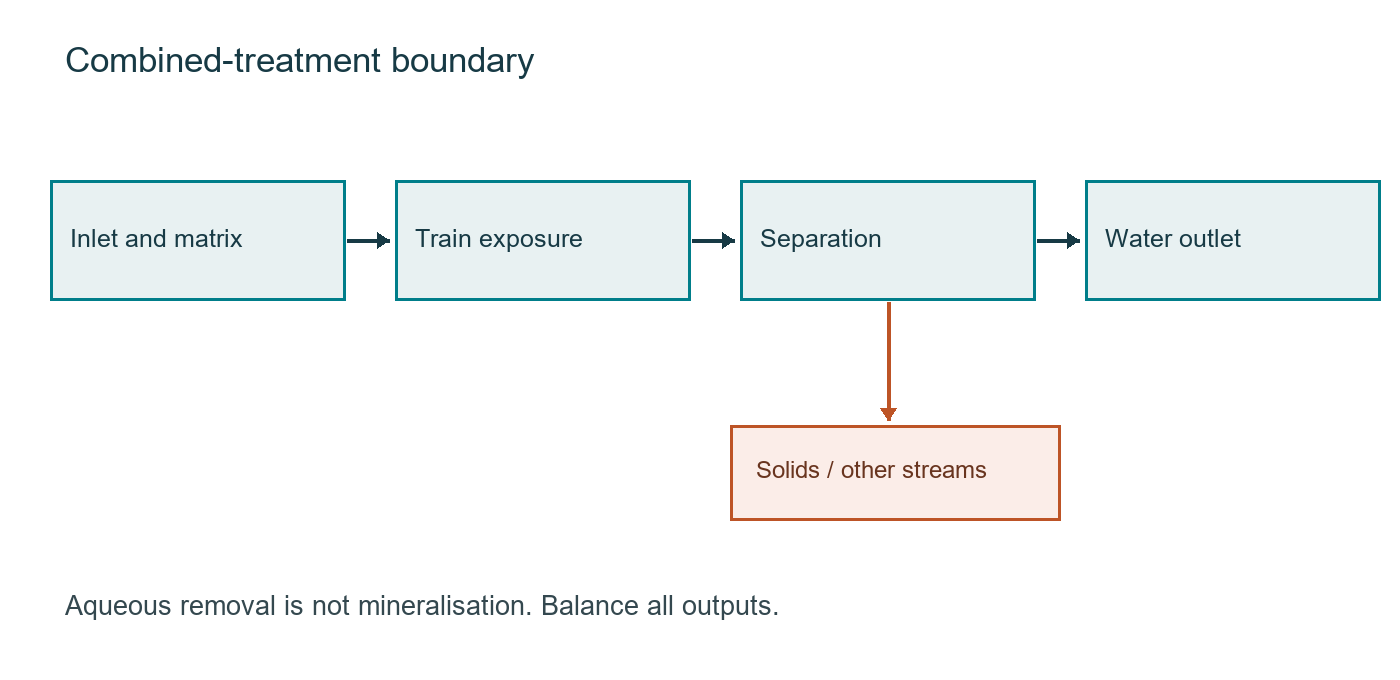
The balance starts with water. Feed, added water, samples, purges, sludge moisture and relevant losses must be counted. Otherwise, a concentration decrease may reflect dilution. For each conserved component, the structure is:
accumulation = inputs - outputs + generation - consumption
For an element, such as total carbon, net generation and consumption vanish when all its forms are included and no nuclear reactions occur. For a chemical species, transformation and formation do occur. COD is not a conserved elemental mass: it is a property expressed as oxygen equivalents. An elemental closure must not be forced using COD alone.
For carbon, the liquid can contain organic and inorganic fractions; solids retain both, and gas can carry inorganic carbon or volatile organic compounds. Detected CO2 does not alone demonstrate contaminant mineralization: it can also originate from initial inorganic carbon released as conditions change. Background corrections and a coherent boundary are required.
EC introduces metal from the electrode; aeration introduces gas; any dosing introduces additional matter. A balance cannot treat these operations as boxes that only remove material. Sludge samples must likewise refer to dry mass or declared moisture, avoiding comparisons between wet kilograms and water concentrations as though they were equivalent quantities.
Synthetic Example 1: Following Carbon, Not a Label
Imagine a batch with 1.00 kg of initial organic carbon and no other carbon inputs. At the end, a hypothetical inventory identifies 0.55 kg of organic carbon in water, 0.30 kg in solids, 0.10 kg of additional recovered inorganic carbon and 0.05 kg unaccounted for. All figures are teaching assumptions, not T1 measurements.
The decrease in aqueous organic carbon is 0.45 kg. This does not equal 0.45 kg mineralized: 0.30 kg is assigned to solids. The 0.10 kg of inorganic carbon is compatible with transformation only after correcting the background and excluding alternative sources; the remaining 0.05 kg is still a discrepancy, not a demonstrated reaction.
The practical decision is to improve recovery and sampling before attributing the unaccounted term. Had only water been measured, interpretation would have confused separation with transformation. This reasoning also explains why intermediate separation can improve outlet quality without necessarily increasing mineralization.
Additive Reference and Synergy
For two hypothetically independent stages acting on the same fraction, with reductions r_A and r_B defined relative to their own inlets, sequential combination is:
C_AB = C0 * (1-r_A) * (1-r_B)
r_AB_reference = r_A + r_B - r_A*r_B
It is not r_A+r_B, because the second stage receives less mass. Nor is this a law for actual operations: it assumes that r_B remains applicable after A and that the analytical variable and boundary remain unchanged. That transferability is precisely a hypothesis requiring testing.
For effects on removed mass, a contrast can be defined as I = Y_AB-Y_A-Y_B+Y_0, with Y the response and Y_0 the control. A favourable value only indicates interaction on that response scale and within that design; it does not identify a chemical mechanism. The contrast requires matching A's dose between A and AB, and B's dose between B and AB, while controlling time and hydraulic conditions. AB consuming the sum of both resources does not itself invalidate the contrast; changing those component doses between arms confounds interaction and dose. The reference model must be written before interpreting the result, not selected afterwards to manufacture an advantage.
Synthetic Example 2: A Comparable Budget
Assume a per-batch budget of 12 Ah total charge and 1.20 kWh total measured energy. A hypothetical train allocates 4 Ah to EC and 8 Ah to EO; energy includes pumps, power supplies, aeration and separation within the agreed boundary. These numbers are solely an accounting exercise, not operating setpoints.
Comparing this train with EC at 12 Ah and EO at 12 Ah matches total charge but does not guarantee equal energy: voltages and auxiliaries may differ. Comparing it with each process at 1.20 kWh does not guarantee equal charge either. Both quantities must therefore be recorded, and the budget defined as either an equality or a limit.
One methodological solution is to investigate feasible conditions under the same limits and report the resources each actually consumes. To isolate local interaction, another comparison preserves each component's dose and uses time and circulation controls; it answers a different question from the fixed-budget economic comparison. Energy should not be artificially wasted to feign equivalence. If both constraints cannot be matched, the unresolved question must be stated.
Mini-Protocol 3: Distinguishing Sequence and Separation
A homogenized batch is divided between a hydraulic control, EC with separation, EO alone, and EC with separation followed by EO. Where the question requires it and operation is technically safe, an EC-to-EO arm without intermediate separation is added. Waiting time, sampling and analytical preparation remain comparable; resources for each stage are recorded.
The comparison with and without separation investigates whether phase removal explains the difference. To test order, another arm applies EO followed by EC, preserving each operation's dose and observing its actual inlet. If switching an operation off changes the circuit, that change is characterized: “without current” does not necessarily mean “without interaction with the electrode”.
HC and aeration are incorporated through specific controls, not assigned the unexplained remainder of a balance. A circulation control characterizes mixing and temperature; a transfer experiment distinguishes aspirated air from transferred oxygen. The questions are whether the fraction available to the next stage changes and whether the advantage persists when sample preparation and relevant resources are matched. Replication design belongs to the statistical chapter; this chapter establishes the causal comparison to be replicated.
Precedents Without Appropriating Results
Paramanik and colleagues studied EC before HC with variants including air and oxidants in rice-mill effluent. The abstract confirms that related hybrids exist; it does not establish the exact EC, EO, HC and Venturi combination or a joint T1 curve. The coverage used is the abstract, not the full text. Hybrid study, 2026.
Amaral-Silva, Martins, Castro-Silva and Quinta-Ferreira integrated physical separation, coagulation/flocculation and Fenton treatment in olive-mill wastewater. Their abstract provides a different example of integration and separation after oxidation. It does not investigate T1 or demonstrate recirculation-induced cavitation; scale is not inferred from the title. Integration study, 2016.
These precedents are useful for formulating comparisons, not importing performance. A defensible interaction claim preserves traceability of matter, exposure and resources, admits unfavourable results, and explains which observation would distinguish rival hypotheses. This can improve the method without presenting the literature library as automatic validation of its coefficients.