Tests, pilot trials and hire
Laboratory tests on your sample, a pilot on your site, and hire of pilot or full systems in Spain. This is the ordinary path before sizing.
See optionsIndustrial discharges with difficult organic load, colour, odour or compounds biology will not degrade. We design treatment systems with advanced oxidation processes, as the main stage or as an add-on to an existing WWTP (EDAR).
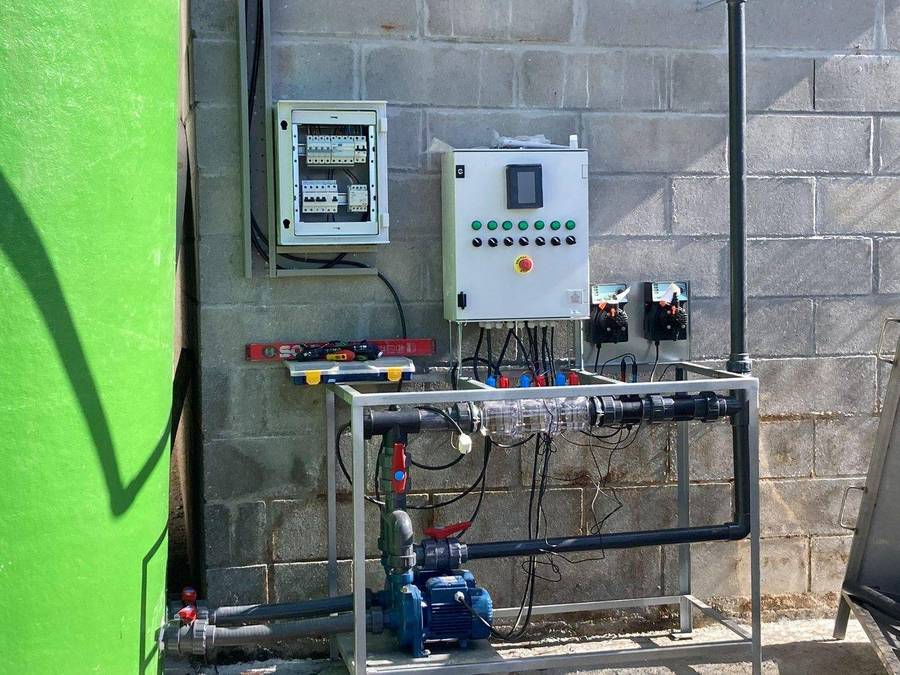
Biological treatment takes most of the load, but there are fractions it will not degrade and peaks it will not absorb. That is where the problems show up.
COD that will not drop even when biology is working: the ratio of total load to biodegradable fraction shows there is matter sludge cannot eat.
Coloured or odorous effluent that reaches the discharge point and draws complaints and enforcement, even when other parameters are in range.
Campaigns and wash-down shifts that multiply the load for weeks and destabilise a biological plant sized for the average.
When the sewer operator’s contract or your discharge conditions penalise excess organic load or solids: cut it before you discharge.
The more sludge you generate, the more it costs to manage. Cutting load upstream cuts that recurring cost.
There is no room to enlarge ponds or reactors. You need a compact stage that works on the plant you already have.
Advanced oxidation processes (POAC) generate highly reactive, short-lived oxidants inside the reactor itself. The point is not to replace conventional treatment, but to attack what it does not degrade.
A real sample and lab analysis: organic load, solids, pH, conductivity, colour, and the flow regime (continuous, batch or campaign).
Solids separation, equalisation and pH adjustment. Oxidation works far better on water without solids and with pH under control; skipping this step makes everything that follows more expensive.
A POAC stage sized by contact time and oxidant dose, in the configuration the test indicates. We also use electrolysis when it is better not to store reagents on site.
Final filtration and measurement of the control parameters to check the water leaves as agreed and to leave a running log.
The system is connected where it pays — before or after biology — without rebuilding the plant. In many sites it is the fastest, least invasive route.
Be careful with the figures. The performance of an advanced oxidation process depends on the water matrix, contact time and the dose applied. The simulator below shows orders of magnitude with a cycle model; it is not a commitment. First we test your sample and, on that result, we write down the achievable targets and the associated consumption.
Refractory fraction, colour and odour: the POAC stage acts on exactly what stops the effluent complying.
A skid on a frame that slots into the existing line. It takes little space and does not force a rebuild of the WWTP.
Cutting load before discharge hits two recurring costs directly: sludge management and the discharge bill.
Design parameters and a control log, available for your discharge permit and for your internal audit.
The water does not pass the unit once: it recirculates, and each pass removes part of what is left. Enter your flow rate and lab analysis (or leave the example values) and you will see what a T1 module would do alone, what a conventional WWTP would do, and what the two do together. The rules are published below, under “How this is calculated”.
What each bar means. “Inlet” is your water. “Conventional WWTP/EDAR” is what a conventional plant sized for ordinary urban load would do. “T1 only · no WWTP/EDAR” is the machine alone. “WWTP/EDAR + T1” is the T1 working on what the existing treatment leaves, which is the usual upgrade layout. The ✓/✕ marks compare the estimated outlet with the limit shown: this is guidance, not certified compliance. If you discharge to a municipal sewer, you can find the WWTP that receives your municipality’s water on the map of WWTPs in Spain.
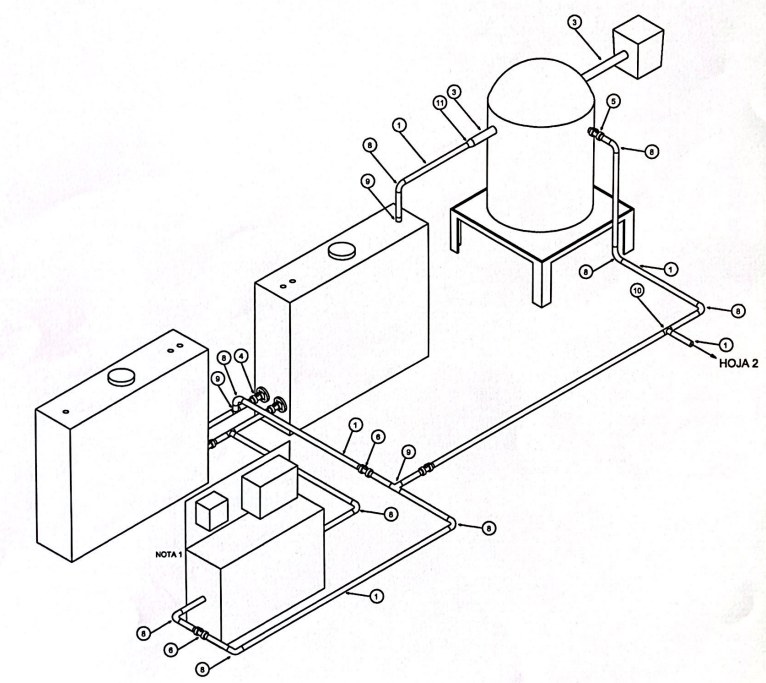
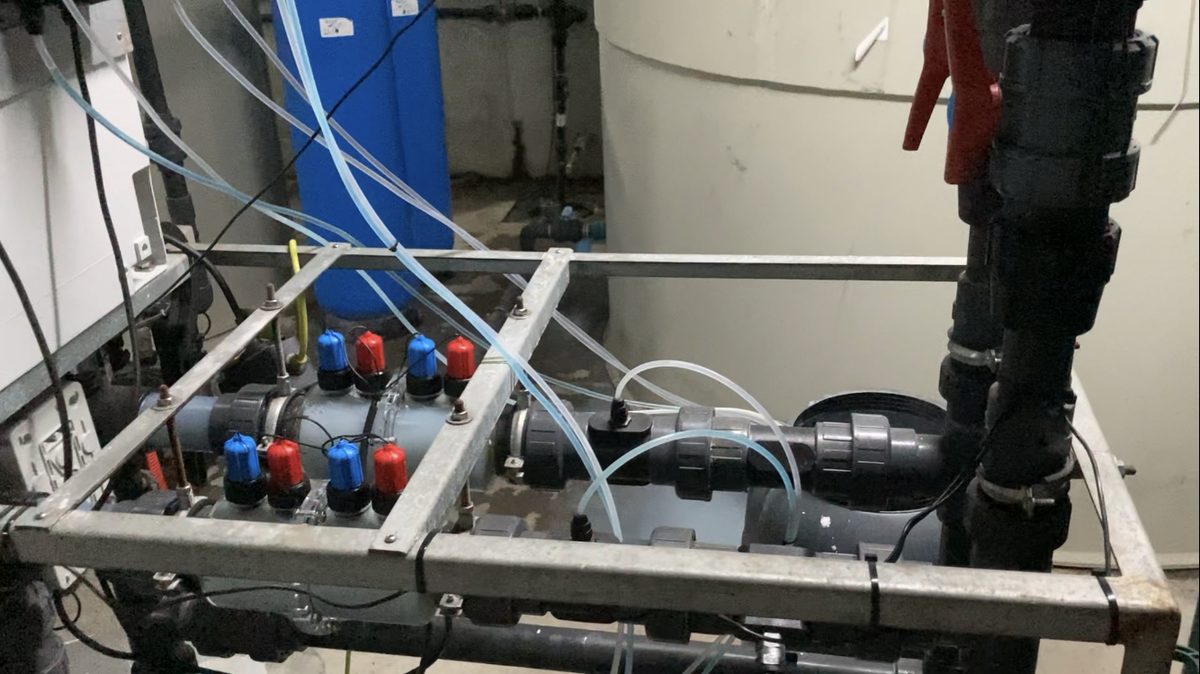
The simulator does not apply a single percentage. That is the first thing to know, because it is what almost everyone does and it is where the disappointments come from: the same unit does not perform the same on one water as on another, and saying “it cuts 80%” without looking at the water means nothing.
Behind it is our own model that chains several rules. We do not publish them in detail — they are part of the know-how of the system — but we do publish what they take into account, which is what lets you judge whether the number makes sense for your case.
From our own tests with inlet and outlet measured on the same water, not from a catalogue or from the literature. When a value is not backed by one of our tests but by the chemistry of the process, we say so in the note for that parameter: we would rather you knew now than later.
And a decision worth explaining, because it goes against commercial instinct: the values you see include a safety margin below what we have measured. In our tests the system did more than this simulator promises. We would rather the real installation surprise you upwards.
Below a certain concentration the simulator stops going down. That is not a limit of the unit: it is that the laboratory can no longer tell the difference, and we do not commit to what cannot be measured.
The bar “WWTP (EDAR) + T1” does not add performances: it chains them. The T1 works on what the treatment you already have leaves. That is the logic of retrofit —intensify without expanding— and it is the layout in which the system gives its best cost/result ratio.
A conventional WWTP sized for ordinary urban load that is receiving more than it was designed to treat. That is why its performance falls as the inlet rises. A new plant sized for that load would do better; we compare against what is installed, which is the real retrofit case.
All performance figures assume pretreatment already in place: coarse screening, grit removal and grease and floatables separation. Without that no performance is demandable — sand erodes the electrodes and free grease cuts current transfer.
The discharge limits shown as a reference (25 mg/L BOD₅ · 125 mg/L COD · 15 mg/L N · 2 mg/L P) are indicative. The limit that applies to each case is the one in your discharge permit, which can be substantially tighter.
Want the number tightened for your water? Send us the lab analysis. We do the detailed calculation, with your case in front of us, and we walk you through it.
Size of the existing WWTP. The “conventional WWTP/EDAR” bar is weighted by the size of the plant used for comparison: small WWTPs have fewer polishing stages. According to Spain’s official 2023 report to the EU (Waterbase-UWWTD), 40 % of plants under 2,000 p.e. have tertiary treatment and 38 % declare nitrogen removal, against 81 % and 58–71 % of those over 50,000; for phosphorus, 24 % against 60 %. The official return starts at 2,000 p.e., so the smaller plants listed are few and do not stand for all that exist. The simulator weights a little for that: if you do not touch the slider, size is estimated from the flow rate (a conventional plant sized for that flow, with an allowance of 185 L per population equivalent per day, the median measured at the Spanish plants that publish their flow; on the map of Europe, each country’s own); if you arrive from the map, from the p.e. of your WWTP. It is an indicative weighting on equipment, not a measure of any particular plant’s performance, and least of all of yours.
Metals are mainly a drinking-water treatment (arsenic and manganese of geological origin, iron that clouds the water, lead from indoor pipework) and their values are measured in µg/L, a thousand times below discharge limits. That is why they sit in their own block and are given as a range, not as a single figure. Use the pH indicated above.
| Meat plants and slaughterhouses | Blood, exudates and fat: heavily loaded effluent that varies with wash-down shifts. A sector with T1 modules in operation. |
|---|---|
| Fish canning, fisheries and aquaculture | Brines, emulsified oils and greases and fine solids; seasonal campaigns. |
| Dairy and cheese plants | Whey and wash water with high organic load and detergents. |
| Chemicals, soaps, inks and pharmaceuticals | Colour, emulsions and poorly biodegradable compounds that biology does not degrade. |
| Automotive, metal and machining | Oils, cutting fluids and metals; emergency oil removal and polishing before discharge. |
| Concrete plants, quarries and timber | Suspended solids, pH and wash water that is worth recirculating. |
| Industrial wash and service stations | Detergents, greases and hydrocarbons, with a direct interest in reusing the treated water. |
| Industrial estates and collectors | The need to cut load before handing it to the municipal sewer, under contractual limits. |
| Small WWTPs and private plants | Plants that comply on average but fail at peaks: the POAC stage acts as a buffer. |
| Sites with no room to expand | When there is no room for another pond, the route is to intensify treatment, not to increase volume. |
Substances present in water at very low concentrations that conventional treatment plants are not designed to remove: pharmaceutical residues, hygiene and cosmetic products, pesticides, perfluorinated compounds (PFAS) or microplastics. Directive (EU) 2024/3019 introduces a quaternary treatment for them in large agglomerations, with staggered deadlines.
With a stage added after biological treatment: advanced oxidation, activated-carbon adsorption or membranes. Advanced oxidation breaks the molecule down instead of moving it to another medium. What is achieved with each water is not promised: it is determined by a test on your sample.
Test your effluent in the laboratory, run a pilot at your plant and size a combined advanced-oxidation stage (electrolysis, electrocoagulation and cavitation) at the outlet of your treatment plant or your process. Start with the configurator or send us your effluent.
Laboratory tests on your sample, a pilot on your site, and hire of pilot or full systems in Spain. This is the ordinary path before sizing.
See optionsElectrocoagulation, electrolysis and hydrodynamic cavitation in recirculation inside a shipping container, factory pre-commissioned. For industry and export.
See LA PERLAGuideline prices for T1 modules (base unit, plus VAT, approximate): T1-16 €18,000 · T1-32 €25,000 · T1-50 €37,500. Installation, pretreatment and commissioning are quoted with the study; the prior test fee is deducted from the order. Test, pilot and hire.
The starting point is always the same: flow rate, lab analysis and which limit you need to meet. With that we propose the test and then the design.
If you do not have a full analysis, tell us the process and the discharge point: we will say which parameters are worth measuring first so you do not spend on unnecessary tests.
The natural next step: if the water already leaves treated, put it back to work in the plant instead of discharging it.
View solutionRegulación de pH y reducción de suspended solids en plantas de áridos y canteras.
View solutionOne sample and one lab analysis are enough to know whether advanced oxidation solves your case and with what reach. We put it in writing.