LA PERLA: the advanced-oxidation plant that arrives in a container
Three processes that work in recirculation —electrocoagulation, electrolysis and hydrodynamic cavitation— governed by a single control panel, assembled, wired and factory-tested inside a 20- or 40-foot shipping container. No biological treatment, no mandatory chemical dosing, no UV.
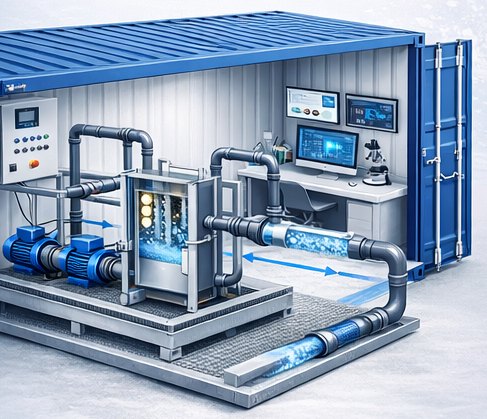
What is inside the container
The three processes back each other up: what cavitation breaks, electrocoagulation aggregates; what electrocoagulation does not reach, oxidation works on. That is where the name combined advanced oxidation comes from.
| Electrocoagulation | It generates the coagulant inside the unit itself, by controlled dissolution of the electrodes. It destabilises and aggregates colloids, fine solids, emulsified greases, phosphorus and metals. |
|---|---|
| Electrolysis | It generates oxidant species in the water itself, without adding reagent from outside. |
| Hydrodynamic cavitation (Venturi) | It breaks emulsions and stable colloidal structures and improves contact and transfer inside the system. |
Designed to run without consumables
The coagulant is not bought: it is generated in the unit. As long as there is electricity, there is treatment. The system accepts coagulant–flocculant and calcium hypochlorite as support to polish and absorb peaks: they are optimisation levers, not requirements.
No biomass to acclimatise or lose
It starts and stops with no penalty and lives well with intermittent or seasonal production. It does not require a qualified operator every day: simple routines and periodic replacement of the electrodes, which are the wear item.
Installed in weeks, not as civil works
It arrives pre-commissioned and factory-tested (documented FAT): no process civil works and no field assembly. It is a movable asset: a container can be relocated if the site changes.
Four sizes, one process
| Configuration | Reference flow rate | Container |
|---|---|---|
| LA PERLA 20 | up to 50 m³/day | 20 ft |
| LA PERLA 20 HC | up to 100 m³/day | 20 ft high cube |
| LA PERLA 40 | up to 300 m³/day | 40 ft |
| LA PERLA MODULAR | over 300 m³/day | several containers in parallel |
Flow rate is not what sizes the unit. What sizes the unit is contaminant load and the conductivity of the water: conductivity determines the achievable current and, with it, the real treatment capacity. Two 60 m³/day plants with different effluents are two different units. That is why we ask for the data sheet before quoting: average and peak flow, hourly and seasonal regime, COD, BOD₅, suspended solids, oils and greases, conductivity, pH, temperature and required outlet quality.
Guideline price
Guideline bands in euros, net, FCA Milladoiro (Ames, A Coruña), excluding tax. LA PERLA is built to order: the final figure is set by project after the data sheet and adaptation engineering, and may sit outside these bands depending on customisation. Reference: framework conditions of September 2026.
| Configuration | Reference flow rate | Guideline band (€, net, FCA) |
|---|---|---|
| LA PERLA 20 | up to 50 m³/day | 118.000 – 142.000 |
| LA PERLA 20 HC | up to 100 m³/day | 165.000 – 198.000 |
| LA PERLA 40 | up to 300 m³/day | 285.000 – 340.000 |
| LA PERLA MODULAR | over 300 m³/day | quoted per project |
Included in the scope: first-year consumables kit, remote training train-the-trainer (20 h) and documented FAT. Extra: spare electrode set, telemetry and remote supervision, on-site intervention, country-risk premium and export logistics, and optional consumables.
Two application modes and one limit we do not negotiate
Mode A · Intensify an existing plant
The main and most proven application. LA PERLA is integrated into treatment that already exists but has fallen short: it works upstream or in recirculation, removing load before it reaches the process that is failing. Optimise without expanding. Here the result commitment is firm.
Mode B · Compact stand-alone treatment
Case by case and always after characterisation. It works well when the load is dominated by suspended solids, greases and oils, colloidal matter, colour, phosphorus or metals: exactly where electrocoagulation performs exceptionally.
The limit. The electrochemical route does not replace biological treatment against high soluble BOD. If the effluent is dominated by soluble BOD, the correct solution is LA PERLA in Mode A accompanying a biological stage. Saying so in advance does not weaken the proposal: it holds it up.
What reduction to expect
LA PERLA works in recirculation: performance does not depend on the size of the unit, but on how many cycles the volume to treat completes. Precondition: without pretreatment (screening, grit removal and coarse grease separation) no performance is demandable.
Rule by cycles
| Recirculation cycles | Share of the achievable maximum |
|---|---|
| 1 | ~50 % |
| 2 | ~75 % |
| 3 | ~87 % |
| 4 | ~94 % |
| 5 | ~97 % |
| 6 (practical cap) | ~98 % |
Each pass brings the water closer to its maximum. Each pass removes about half of what is still left to remove: with 1 pass you cover half the path, with 4 the 94 % and with 6 the 98 %. Beyond that, continuing to recirculate consumes energy and electrode without gaining quality. The path has an end of its own for each parameter: that is the table on the right. Below 3–4 cycles we do not commit results in writing. The number of cycles comes from three figures: the unit’s recirculation flow, operating hours per day and the volume to treat.
Reductions we will commit to
With correct pretreatment and in the 4–6 cycle range. They incorporate a 20 % safety margin on what we have measured in our own tests. Rows with an asterisk rest on the chemistry of the process (they travel with the solids), not on our own test.
| Suspended solids | 52 – 67 % |
|---|---|
| Turbidity * | 70 – 78 % |
| Emulsified oils and greases * | 70 – 78 % |
| Colour * | 68 – 78 % |
| Total phosphorus | 68 – 76 % |
| Metals | no single percentage: it depends on each metal and on pH (see note) |
| Total COD | 48 – 64 % |
| BOD₅ | 48 – 72 % |
| Total nitrogen | depending on its form: of the order of 50 % if it is mainly organic or particulate (see note); with your analysis we will tell you what to expect |
These ranges assume pretreatment already in place (screening, grit removal and grease separation) and 4 to 6 recirculation passes. The contractual commitment is closed on a real analysis of your water and, when the case requires it, on a prior test.
Metals
We do not give a single percentage, because each metal behaves differently. Electrocoagulation generates a metal hydroxide that carries metals by coprecipitation and adsorption, and there pH matters more than the number of passes: each metal has a pH band in which its hydroxide is less soluble. With the analysis in front of us we say what to expect of each one, and what not: there are metals this route does not remove, and we would rather say so before than after.
Nitrogen
It depends on the form it arrives in. Nitrogen organic and particulate (protein, product residue) is removed well: in our own test on fish-processing water we brought it down from 89 to 19 mg/L. With your analysis in front of us we will tell you what to expect in your case and, if it is the right fit, the correct configuration is LA PERLA plus a biological stage: we will tell you even if it means selling you less machine.
Three inlet-load scenarios and estimated outlet
Reference scenarios defined by inlet COD (COD/BOD₅ ≈ 2, COD/N ≈ 30). Outlet applying the conservative end of the range. Values in mg/L.
| Parameter | Scenario 1 · high load inlet → outlet | Scenario 2 · medium load inlet → outlet | Scenario 3 · moderate load inlet → outlet |
|---|---|---|---|
| COD | 10,000 → 5,200 | 5,000 → 2,600 | 2,000 → 1,040 |
| BOD₅ | 5,000 → 2,600 | 2,500 → 1,300 | 1,000 → 520 |
| Suspended solids | 4,000 → 1,920 | 2,000 → 960 | 800 → 384 |
| Oils and greases | 1,400 → 420 | 700 → 210 | 280 → 84 |
| Total phosphorus | 80 → 26 | 40 → 13 | 16 → 5 |
| Total nitrogen | 330 → 304 | 165 → 152 | 65 → 60 |
In scenarios 1 and 2 LA PERLA does not take the effluent to final quality on its own: it removes between half and three quarters of the load and hands the later treatment a water that is radically more manageable (Mode A). Where the load is colloidal or particulate, performances are high and stable; on refractory dissolved COD the reduction is limited. Behind these ranges sit ten years of design, build and operation of combined advanced-oxidation systems in recirculation.
Where it does not go, in our own words
- Dissolved salts and conductivity. The system does not desalinate.
- Sludge still has to be managed. What is taken out of the water does not vanish.
How we work outside Spain
Lead times
Adaptation engineering and configuration validation: 2–3 weeks. Build, container integration and FAT tests: 12–16 weeks. Ready for loading (FCA Milladoiro) immediately after FAT. The clock starts from a confirmed, paid order.
Support at destination
Remote by design: telemetry with access to the control panel, training train-the-trainer of 20 hours with a manual in Spanish, English and French, and remote technical support during the warranty. On-site intervention is possible and billed separately.
Terms
Direct sale, quoted, invoiced and collected in euros, 100 % in advance before we build, FCA Milladoiro (Ames, A Coruña). Prior engineering fee, deductible from the order. First-year consumables kit included in the scope. All collections into Aguas SB accounts at Spanish banks: we never communicate account changes by email.
References. Ours are European: fish and canning, meat, food, aquaculture, concrete plants and quarries, and urban wastewater. The first unit in a new territory is treated as an implantation project, with the commercial recognition that deserves. The full technical and commercial dossier is delivered once the distribution or representation relationship is formalised.
Send us the data sheet and we will say which configuration fits
Average and peak flow, hourly and seasonal regime, COD, BOD₅, suspended solids, oils and greases, conductivity, pH, temperature and required outlet quality. With that we place your effluent in one of the three scenarios and propose the test or the configuration.